
2026-10-28
Wrecked Warplanes and Bamboo Shafts: How Two Rebels Invented Modern Ice Climbing
When we watch modern alpinists like Jeff Mercier or Will Gadd scale a dead-vertical pillar of glacial ice, they make movement on frozen water look effortless. With a flick of the wrist and a subtle kick of the toe, steel bites into blue ice and the climber floats upward.
Yet prior to 1966, climbing a vertical frozen waterfall was considered physically impossible. The transformation of ice climbing from an exhausting, slow-motion slog into a vertical martial art did not come from a corporate laboratory. It was born from snapped wooden shafts, salvaged World War II airplane wreckage, and two obsessive rebels on opposite sides of the Atlantic.
Before 1966: The Staircase Problem
For more than a century, mountaineers approached alpine ice the same way medieval masons approached stone: by carving steps. Climbers carried unwieldy, three-foot wooden axes that functioned more like heavy walking sticks than technical climbing tools. To ascend an icy slope, a climber had to spend hours swinging away to chop tiny, flat platforms into the ice like a giant staircase.
The margins for error were terrifyingly thin. If your wooden shaft snapped in the bitter cold, or if your forearms simply gave out from hours of repetitive chopping, you fell to your death. Even worse, true vertical frozen waterfalls remained completely untouched. You simply cannot chop a staircase into a 90-degree wall of ice while hanging by one hand.
The Eccentric Scotsman and Wrecked Airplanes
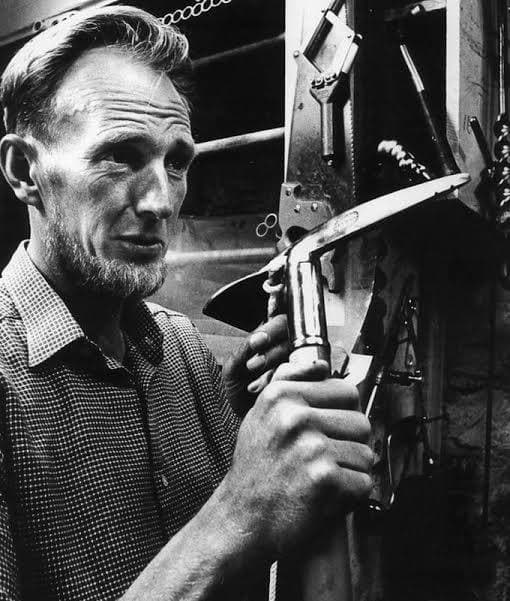
The first breakthrough arrived in the brutal winter storms of Glencoe, Scotland. Its architect was Hamish MacInnes, a legendary Scottish mountaineer, author, and relentless tinkerer. Known for his eccentric brilliance, MacInnes had built his own car from scratch at age sixteen and once survived an avalanche that buried him alive. What he could not tolerate, however, was the alarming regularity with which traditional wooden ice axes snapped inside steep Scottish winter gullies.
In the 1960s, MacInnes looked at the wreckage of World War II airplanes scattered across the British Isles and saw the future of alpinism. Salvaging high-tensile aluminum tubing from crashed military aircraft, he engineered the world's first all-metal ice axe and gave it an unforgettable name: the Terrordactyl.
Beyond its unbreakable metal shaft, the Terrordactyl featured a radical, steeply drooped pick lined with aggressive teeth. Instead of chopping steps, a climber could swing the tool overhead like a dagger. The angled metal teeth locked straight into solid, vertical ice, allowing Scottish climbers to pull their entire body weight upward without carving a single step.
A Californian Blacksmith Travels to Scotland
Around the same time, thousands of miles away in California, another iconoclast was wrestling with the exact same problem. Between 1966 and 1969, Yvon Chouinard (who would later found Patagonia and Black Diamond) was living out of his car, surviving on cans of cat food to save money, and forging custom rock climbing hardware on a portable coal-fired anvil.
Frustrated by how poorly traditional European ice axes bounced and shattered against steep American ice, Chouinard made a pilgrimage to Scotland to climb alongside MacInnes and study the bold new winter tactics emerging from Glencoe. What Chouinard witnessed in those freezing Scottish gullies sparked a geometric revelation.
The Banana Curve and the Bamboo Masterpiece
While MacInnes's Terrordactyl used a straight pick set at a steep angle, Chouinard analyzed the biomechanics of the human body. He realized that when a climber swings an axe overhead, the human arm naturally travels in a circular arc. If a pick is straight, it fights the natural trajectory of the swing, shattering the surface ice instead of slicing cleanly into it.
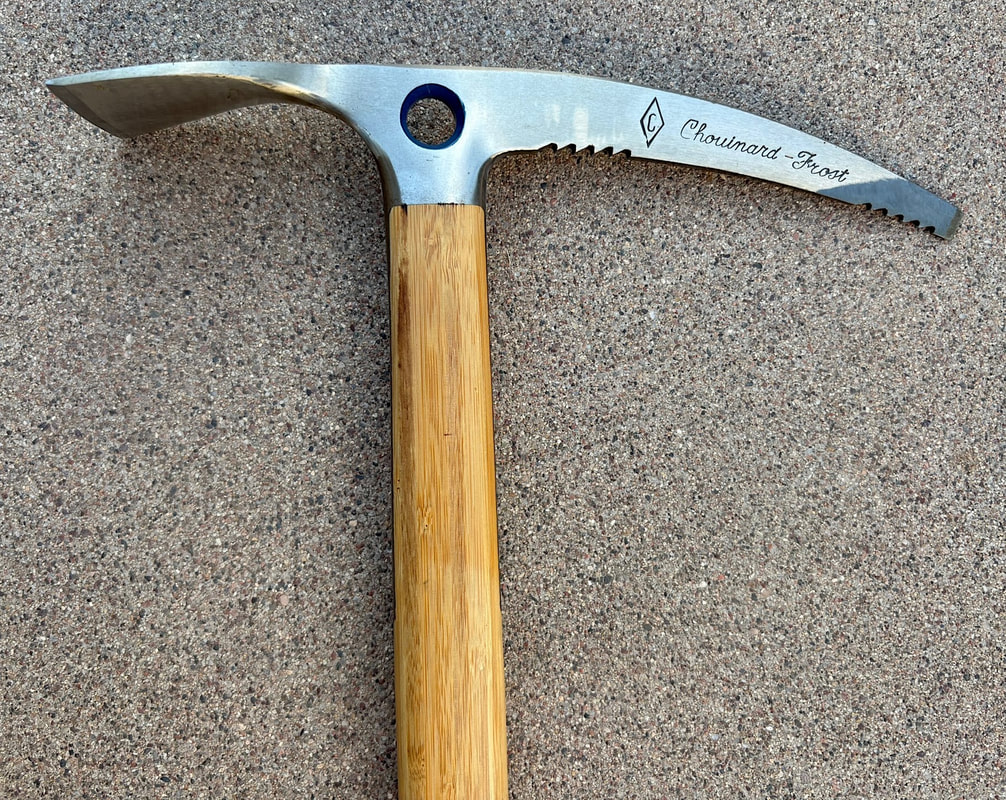
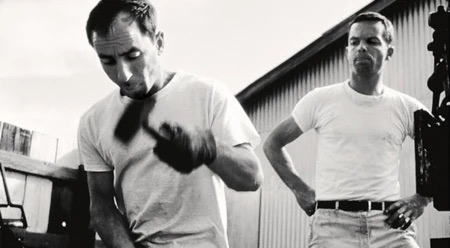
Teaming up with his climbing partner and aerospace engineer Tom Frost, Chouinard forged a steel pick with a gentle downward banana curve that matched the exact radius of a human swing. They mounted this curved steel head onto a shaft of ultra-strong laminated bamboo, unveiling the legendary 1969 Chouinard-Frost Piolet. To complete the system, Chouinard forged rigid steel crampons with sharp front points so a climber's leather boots would never flex under load.
"Overnight, the staircase was obsolete. For the first time in human history, an alpinist could hang their entire body weight off four tiny points of steel and walk straight up a 400-foot frozen waterfall."
From Glencoe Gullies to the Silver Screen
The revolution sparked by MacInnes, Chouinard, and Frost redrew the boundaries of the vertical world. Frozen waterfalls in the Canadian Rockies, the French Alps, and the glaciers of Iceland were suddenly transformed from impossible barriers into coveted playgrounds.
And in a fitting twist of history, Hamish MacInnes's mechanical genius did not stay confined to Scottish winter gullies. Because of his unmatched mastery of rigging and mountain safety, Hollywood came calling. MacInnes was hired as the mountain safety and stunt-rigging mastermind on iconic films including Sean Connery's alpine thriller The Eiger Sanction and, memorably, Monty Python and the Holy Grail, where he engineered the famous Bridge of Death over a Glencoe gorge.
Watch the Evolution of Ice Climbing on ELEVI
Every time a modern ice climber swings a curved carbon-fiber tool into a towering glacial wall, they are tracing the exact arc perfected by Hamish MacInnes and Yvon Chouinard over half a century ago. Want to see what the pinnacle of modern ice climbing looks like today? Stream the award-winning documentary Ephemeral featuring legends Jeff Mercier and Will Gadd exclusively on ELEVI.
Enjoyed this story?
Give this article a like or leave a comment below.
Comments & Discussion (0)
No comments yet. Be the first to start the discussion!
Read Next

2026-10-27
From Wooden Clogs to Everest: The Extraordinary History of La Sportiva
How did a tiny 1928 workshop carving wooden shoes for Dolomite lumberjacks become the most technical climbing and mountaineering footwear brand on Earth? Discover the four-generation story of La Sportiva.

2026-10-13
Where to Watch Dick's-A-Thon: Seattle's Ultimate Burger and Running Challenge
Forget pristine energy gels and corporate marathons. Discover the hilarious, grueling documentary about the grassroots endurance challenge linking Seattle's most iconic drive-in burger joints.